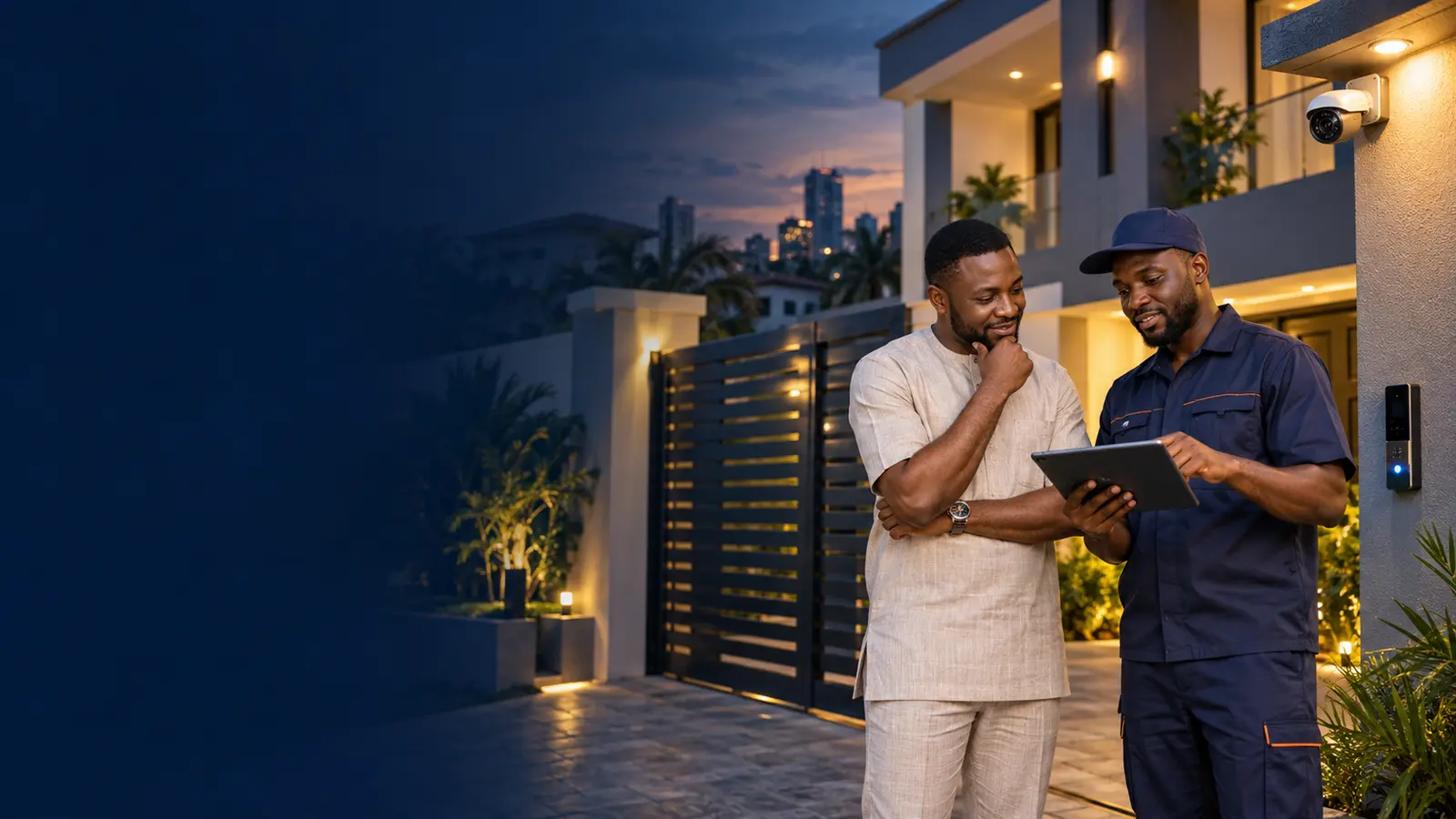
Residential Security in Nigeria: A Practical Smart-Security Guide
In brief: An effective residential security system combines deterrence, controlled access, reliable surveillance, timely alerts and a clear response process. In Nigeria, the design must also account for power interruptions, mobile-network performance, outdoor conditions and the people responsible for acting when an alert occurs.
Start with a residential risk assessment
Security begins with understanding the property rather than selecting cameras or locks from a catalogue. Review entrances, perimeter walls, parking areas, service gates, blind spots, lighting, staff movement and the routines of residents. A detached house, apartment building and gated estate do not face the same risks and should not receive the same design.
A useful assessment identifies what must be prevented, what must be detected, what evidence may be required and who will respond. It should also document existing power, internet, gate-control and security arrangements so new technology supports, rather than disrupts, the way the property operates.
Build security in complementary layers
Visible cameras and warning signs can deter opportunistic activity, while well-positioned cameras provide verification and evidence. Access control manages who can enter; smart locks protect selected doors; intrusion sensors detect activity; and intercom or visitor-management systems improve communication at entrances.
No single device provides complete protection. The strongest design uses each layer for a defined job and avoids unnecessary complexity. Critical entrances should remain manageable during power or internet outages, and residents should understand both normal operation and emergency procedures.
Plan cameras for useful evidence
Camera count is less important than coverage quality. Each camera should have a purpose: identify a person at an entrance, observe movement along a perimeter, monitor a vehicle gate or provide an overview of a shared space. Lighting, mounting height, viewing angle and image detail determine whether footage will actually be useful.
Recording capacity should be designed around resolution, frame rate, recording mode, number of cameras and retention target. Remote viewing is valuable, but dependable local recording is equally important when connectivity is unstable. Access to footage should be limited to authorised users.
Design for Nigerian operating conditions
Power resilience should be planned from the outset using suitable backup arrangements, surge protection and realistic runtime requirements. Outdoor devices need appropriate weather protection, and wireless or mobile-connected equipment should be selected after checking coverage at the installation point.
Maintenance matters as much as installation. Camera lenses become dirty, batteries age, storage devices fail and user permissions become outdated. Scheduled health checks and clear support responsibility help ensure the system still works when an incident occurs.
Choose an installer and measure the outcome
Ask for a documented scope showing coverage objectives, equipment specifications, storage assumptions, power design, network design, warranty and training. A professional proposal should explain why each component is included and how the completed system will be tested.
The result should be measured against practical outcomes: entrances are controlled, important areas are visible, recordings can be retrieved, alerts reach the right people and authorised users know how to operate the system.
Planning checklist
| Decision | What to confirm |
|---|---|
| Objective | The exact safety, security or operating outcome required |
| Environment | Power, connectivity, weather, users and site constraints |
| Evidence and data | Records, retention, permissions, privacy and reporting |
| Resilience | What must continue during power or internet interruption |
| Support | Acceptance tests, training, maintenance, warranty and escalation |
Frequently asked questions
How many cameras does a home need?
The number depends on the entrances, perimeter, layout, blind spots and level of identification required. A site assessment is more reliable than a generic camera count.
Can residential security work when the internet is down?
Local recording, locks and selected automation can be designed to continue operating locally. Remote viewing and cloud notifications normally require connectivity.
Should cameras record continuously or only on motion?
Continuous recording provides the fullest timeline but requires more storage. Motion or event recording conserves capacity. Many systems use a combination based on risk.
How often should the system be maintained?
Routine visual and recording checks should be frequent, with scheduled professional inspection based on the equipment, environment and importance of the site.